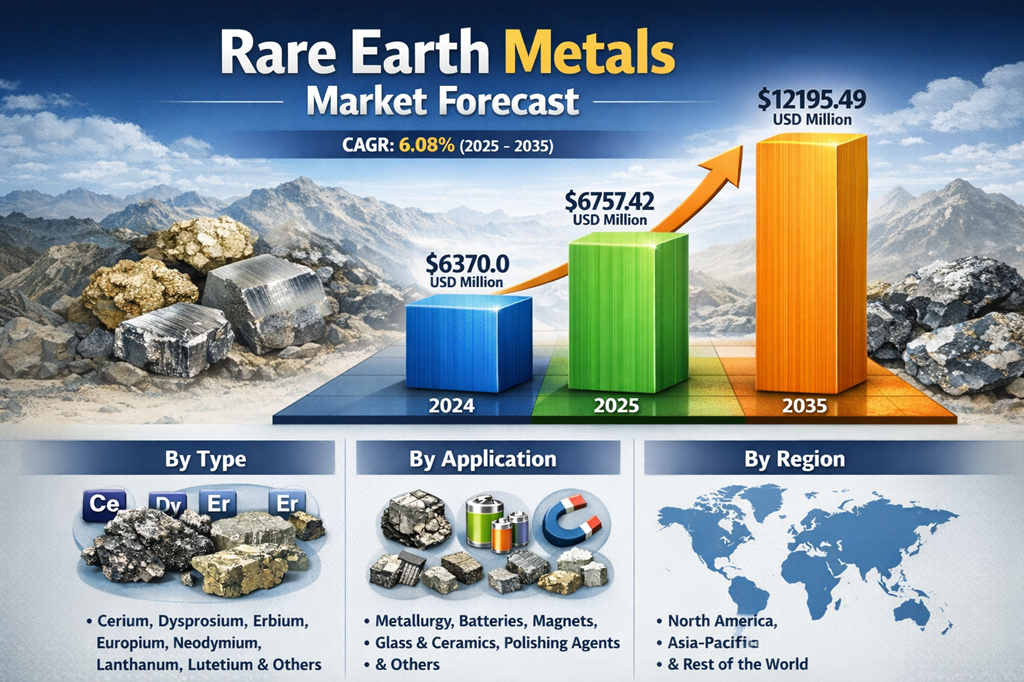
They do not gleam from jeweler’s showcases or command front-page financial headlines the way gold and platinum do. Yet without them, the electric vehicle sitting silently in your garage would not move, the wind turbine spinning on a hillside would not generate a single watt, the smartphone in your pocket would not vibrate, and the precision-guided munition protecting national borders would not find its target. Rare earth metals — a group of 17 chemically similar metallic elements comprising the 15 lanthanides plus scandium and yttrium — are the invisible architecture of modern civilization’s most consequential technologies. Their magnetic, luminescent, and catalytic properties are so exceptional, and so irreplaceable in current engineering practice, that they have earned a designation that transcends commodity classification: critical materials, strategic resources, and in the language of geopolitics, the new oil. According to an authoritative analysis by Market Research Future, the global Rare Earth Metal Market was valued at USD 6,370.0 million in 2024 and is projected to grow from USD 6,757.42 million in 2025 to USD 12,195.49 million by 2035, advancing at a compound annual growth rate (CAGR) of 6.08% over the forecast period. That near-doubling of market value in a single decade is not the product of speculative enthusiasm — it is the mathematical consequence of every major industrial economy on Earth simultaneously betting its energy transition, defense modernization, and digital infrastructure on a class of materials that remain geographically concentrated, technically challenging to extract, and strategically irreplaceable.
What Are Rare Earth Metals and Why Do They Matter?
The term “rare earth” is something of a misnomer. Most rare earth elements are not geologically scarce in absolute terms — cerium, for instance, is more abundant in the Earth’s crust than copper. What makes them rare is the near-impossibility of finding them in economically mineable concentrations, combined with the extraordinary technical complexity of separating individual elements from the mineral matrices in which they co-occur and from each other. The separation process — which exploits tiny differences in chemical behavior between elements with nearly identical atomic structures — requires sophisticated solvent extraction facilities, generates significant radioactive byproduct waste in the case of thorium-bearing ores, and demands chemical engineering expertise that only a handful of nations have developed at commercial scale.
Within the rare earth family, a critical distinction separates light rare earth elements (LREEs) — including lanthanum, cerium, praseodymium, and neodymium — from heavy rare earth elements (HREEs) — including dysprosium, terbium, europium, erbium, and others. LREEs are generally more abundant and widely produced, while HREEs are far scarcer, more geographically concentrated in deposits (predominantly in Southern China’s ionic clay deposits), more technically demanding to process, and command significantly higher prices per kilogram. This distinction matters enormously for the clean energy transition: while neodymium and praseodymium (LREEs) provide the core magnetic force in permanent magnet motors, dysprosium and terbium (HREEs) are the critical additives that prevent those same magnets from demagnetizing at the elevated operating temperatures of electric vehicle motors and wind turbine generators. A world racing to electrify transportation and decarbonize power generation therefore faces not just a rare earth demand surge in aggregate, but a specific, severe, and structurally difficult-to-solve HREE supply challenge.
Key Market Drivers Shaping the Decade Ahead
The Electric Vehicle Revolution and Permanent Magnet Demand: No force is reshaping rare earth metal demand more profoundly than the global transition to electric mobility. Neodymium-iron-boron (NdFeB) permanent magnets — the most powerful permanent magnets known — are the enabling technology for the high-torque, compact, lightweight electric motors that make modern EVs competitive with internal combustion alternatives. Every EV motor requires neodymium and praseodymium for its magnetic core, and high-performance variants operating in demanding duty cycles require dysprosium and terbium additions of 2–5% by weight to maintain magnetic performance at temperature. As global EV production scales from millions toward tens of millions of units annually, the cumulative demand signal sent to rare earth mining and processing chains is enormous and compounding. The market’s projected growth to USD 12.2 billion by 2035 at a 6.08% CAGR is fundamentally anchored in this EV-driven magnet demand wave, with the magnets application segment holding the largest share in the global market.
Download Report Sample Copy with TOC: https://www.marketresearchfuture.com/sample_request/2261
Renewable Energy Infrastructure — Wind Turbines and Beyond: Direct-drive wind turbines — the dominant design choice for offshore wind installations, where maintenance accessibility is limited — rely on large-format NdFeB permanent magnet generators that eliminate the mechanical gearbox, improving reliability and reducing long-term operational costs. Each megawatt of direct-drive offshore wind generation capacity requires approximately 600–700 kilograms of rare earth magnets, making the offshore wind industry one of the most significant and fastest-growing new sources of rare earth demand. As global offshore wind deployment accelerates under net-zero commitments from the EU, the US, China, Japan, South Korea, India, and the UK, the cumulative tonnage of rare earth magnets required for turbine manufacturing represents a demand pipeline that will sustain market growth well beyond the forecast horizon. Baotou HEFA Rare Earth Co.’s long-term supply contract with a major European wind turbine manufacturer for permanent magnet generators, signed in Q2 2025, exemplifies the supply chain partnerships being constructed to service this demand.
Strategic Stockpiling and Supply Chain Security: The rare earth market is unique among commodity markets in the degree to which government policy — rather than purely commercial demand — drives purchasing behavior and investment decisions. China’s dominant position in rare earth mining, separation, and downstream processing (accounting for approximately 60% of global mining output and an even higher share of processing capacity) has made rare earth supply security a top-priority national security concern for the United States, European Union, Japan, South Korea, Australia, and Canada. These nations and regional blocs are pursuing parallel strategies of stockpile building, domestic production incentivization, allied nation supply chain development, and recycling technology investment to reduce their structural dependence on Chinese rare earth supply. The U.S. Department of Energy’s USD 200 million loan to MP Materials in Q2 2024 for construction of a rare earth magnet manufacturing facility in Texas — supplying the electric vehicle and defense sectors — is one of the most visible manifestations of this strategic supply chain investment wave. Japan’s government approval of funding for a domestic rare earth recycling facility in Q1 2025 represents another dimension of the same strategic imperative, pursued through a different technical pathway.
Defense and Aerospace Applications: Rare earth metals underpin a wide array of advanced military and aerospace technologies, from the neodymium magnets in precision-guided munition actuators and radar antenna arrays to the samarium-cobalt magnets preferred for high-temperature aerospace applications, to the europium and terbium phosphors in display systems and targeting optics. As defense budgets expand globally in response to a more complex geopolitical environment, and as defense modernization programs across NATO nations and Indo-Pacific allies accelerate the integration of electronic warfare, directed energy, and autonomous systems technologies, rare earth demand from the defense sector is growing alongside the more publicly discussed clean energy demand wave. This dual-use demand pattern — clean energy and defense both surging simultaneously — creates an unusually robust and diversified demand foundation for the market.
Technological Innovation in Electronics: Consumer electronics, industrial electronics, and emerging technology platforms all depend on rare earth elements for key performance attributes. Neodymium magnets enable the miniaturized vibration motors in smartphones and the voice coil actuators in hard disk drives. Cerium is the primary abrasive in glass polishing compounds, essential for the production of optical lenses, semiconductor wafers, and display glass. Lanthanum contributes to high-refractive-index optical glass formulations used in camera lenses and night vision systems. Europium and terbium power the red and green phosphors in LED and fluorescent lighting. As consumer electronics evolve toward higher performance and more compact form factors, and as new application categories — wearables, AR/VR headsets, autonomous vehicle sensor systems — mature into high-volume markets, the breadth of rare earth demand across the electronics sector continues to expand.
Market Segmentation Insights
By Application — Magnets Lead, Catalysts Grow Fastest: The magnets application segment commands the largest share of the global rare earth metal market, a dominance that will only deepen as EV and wind turbine deployments scale. The catalysts segment — encompassing fluid catalytic cracking (FCC) catalysts in petroleum refining (which use lanthanum and cerium to enhance cracking efficiency and gasoline yield), automotive catalytic converters (which use cerium-based oxygen storage components), and emerging catalytic applications in chemical synthesis — is identified as the fastest-growing application. Phosphors, glass polishing compounds, and ceramics round out the major application categories, each with distinct demand drivers and growth profiles.
By Product Type — Neodymium Dominates, Dysprosium Grows Fastest: Neodymium is the largest individual product type segment by value, reflecting its central role in NdFeB magnet production — the dominant magnet technology across EVs, wind turbines, consumer electronics, and industrial motors. Cerium and lanthanum contribute large volumes in catalyst and glass polishing applications. Dysprosium is identified as the fastest-growing segment, driven by its critical and irreplaceable role as a high-temperature performance additive in NdFeB magnets for EV and wind applications. As EV motor operating temperatures and performance requirements push higher, dysprosium’s strategic value — and the severity of its supply constraint, given its HREE classification and geographic concentration — intensifies.
By Form — Oxides Largest, Alloys Fastest-Growing: Rare earth oxides — the intermediate processing products that serve as feedstock for most downstream applications — hold the dominant form segment position, reflecting the market’s structure where oxide production precedes conversion to metals, alloys, or compounds for specific end uses. Alloys are the fastest-growing form segment, driven by the explosive growth of NdFeB magnet alloy production for EV and wind applications. The shift from oxide to finished alloy production in non-Chinese supply chains — exemplified by MP Materials’ Texas magnet facility and Lynas Rare Earths’ processing operations — represents a significant structural evolution of the market’s value chain geography.
By Purity Level — High Purity Leads, Ultra High Purity Emerges: High purity rare earth materials dominate the market by volume and value, serving the broad demand base in magnets, catalysts, electronics, and energy applications. Ultra high purity rare earth materials are the fastest-growing purity segment, driven by emerging demand in specialized medical technologies, advanced semiconductor manufacturing, quantum computing research, and next-generation catalysis where even trace-level impurities can compromise performance. This purity-driven segmentation illustrates the market’s ongoing evolution from bulk commodity toward differentiated specialty material as downstream application sophistication increases.
By End-Use Industry — Electronics Largest, Automotive Fastest-Growing: Electronics remains the largest end-use industry by value, encompassing the full breadth of consumer, industrial, and professional electronic device applications. The automotive sector — specifically the EV powertrain and associated electronic systems — is the fastest-growing end-use industry, on a trajectory to challenge electronics’ dominance as EV production volumes scale globally through the 2030s.
Buy Now: https://www.marketresearchfuture.com/checkout?currency=one_user-USD&report_id=2261
Regional Market Dynamics
Asia-Pacific is both the largest producing and fastest-growing consuming region for rare earth metals. China remains the world’s dominant rare earth mining, separation, and downstream processing power, with China Northern Rare Earth Group representing the global industry’s largest single entity. However, China’s domestic consumption of rare earth metals — driven by its own massive EV manufacturing industry, wind turbine production base, and electronics manufacturing complex — is growing rapidly, tightening the supply available for export and intensifying the strategic supply security concerns of importing nations.
North America holds the largest regional share among non-Asian markets, projected to reach USD 950 million by end-2025, driven by the defense sector’s substantial and strategically motivated demand and by the accelerating build-out of domestic rare earth supply chains. MP Materials’ Mountain Pass operation in California is the Western Hemisphere’s largest rare earth mining operation, and the company’s expansion — including the Texas magnet manufacturing facility backed by USD 200 million in DOE loan funding and the expanded GM electric vehicle motor partnership — is creating a vertically integrated North American rare earth supply chain for the first time in decades. The U.S. government’s active promotion of domestic production and supply chain resilience through defense procurement mandates, loan guarantees, and tax incentives is a structural support for the regional market that distinguishes it from other commodity markets.
Europe is the world’s most policy-driven rare earth demand market, with the EU’s Critical Raw Materials Act establishing binding targets for domestic rare earth mining, processing, and recycling capacity as a matter of strategic industrial sovereignty. Germany, France, and the Nordic countries are the leading European consumers of rare earth materials, driven by automotive manufacturing, wind turbine production, and advanced industrial machinery sectors. Koehler and Solvay are among the European processing entities serving regional downstream demand, while the EU’s European Raw Materials Alliance (ERMA) is coordinating investment in domestic extraction and processing projects across member states.
Australia has emerged as the most strategically significant non-Chinese rare earth producing nation, with Lynas Rare Earths operating the world’s largest rare earth processing facility outside China at its Malaysian Lynas Advanced Materials Plant (LAMP) and developing a new processing facility in Kalgoorlie, Western Australia. Arafura Resources’ final investment decision in Q3 2024 to proceed with the Nolans neodymium-praseodymium project in the Northern Territory — targeting production of the most critical EV magnet feedstock elements — marks a major addition to the global non-Chinese rare earth supply pipeline.
Competitive Landscape and Key Players
The global rare earth metal market is moderately concentrated at the mining and separation level, with Chinese state-owned enterprises — China Northern Rare Earth Group, Shenghe Resources, China Rare Earth Holdings — collectively dominating global output. Outside China, the competitive landscape is shaped by a small number of significant producers: Lynas Rare Earths (Australia/Malaysia), MP Materials (US), Arafura Resources (Australia), Alkane Resources (Australia), Neo Performance Materials (Canada), Iluka Resources (Australia), and Rare Element Resources (US).
Competitive dynamics are evolving rapidly as the strategic imperative to diversify supply chains away from Chinese concentration drives government-backed investment into non-Chinese producers at a pace and scale unprecedented since the rare earth supply disruptions of 2010–2012. Lynas Corporation’s partnership with a leading technology firm to develop advanced rare earth recycling methods — announced in Q4 2024 — illustrates the sector’s parallel investment in circular economy solutions that could meaningfully supplement primary supply. MP Materials’ expansion of its California production facility by 30% in Q4 2024, its DOE-backed Texas magnet factory, and its expanded GM partnership position it as the United States’ emerging anchor of a fully domestic rare earth-to-magnet supply chain. Arafura Resources’ multi-year supply agreement with Samsung, signed in Q2 2024, demonstrates the growing appetite of major electronics and technology manufacturers to secure direct rare earth supply outside traditional Chinese channels.
For more insights on Market, visit the Market Research Future page and explore detailed market analysis, forecasts, and company strategies.
Rapid Strength Concrete Market
You can also access localized versions of the report in Japanese, French, German, Spanish, Korean, and Chinese for region-specific market intelligence.
Revolving Door Market |Japanies |French |German |Spanish |Korean |China
Passive Fire Proofing System Market |Japanies |French |German |Spanish |Korean |China
Refined Copper Market |Japanies |French |German |Spanish |Korean |China
Recycled Asphalt Market |Japanies |French |German |Spanish |Korean |China
Roof Cladding Market |Japanies |French |German |Spanish |Korean |China
Passive Fire Protection Material Market |Japanies |French |German |Spanish |Korean |China
Undercarriage Component Market |Japanies |French |German |Spanish |Korean |China